
For Attorney · Elder care
From One Intake Call to a Chain-Liability Evaluation
How plaintiff elder-abuse attorneys turn one intake call into a chain-liability evaluation: every facility under an owner, sourced and severity-ranked.
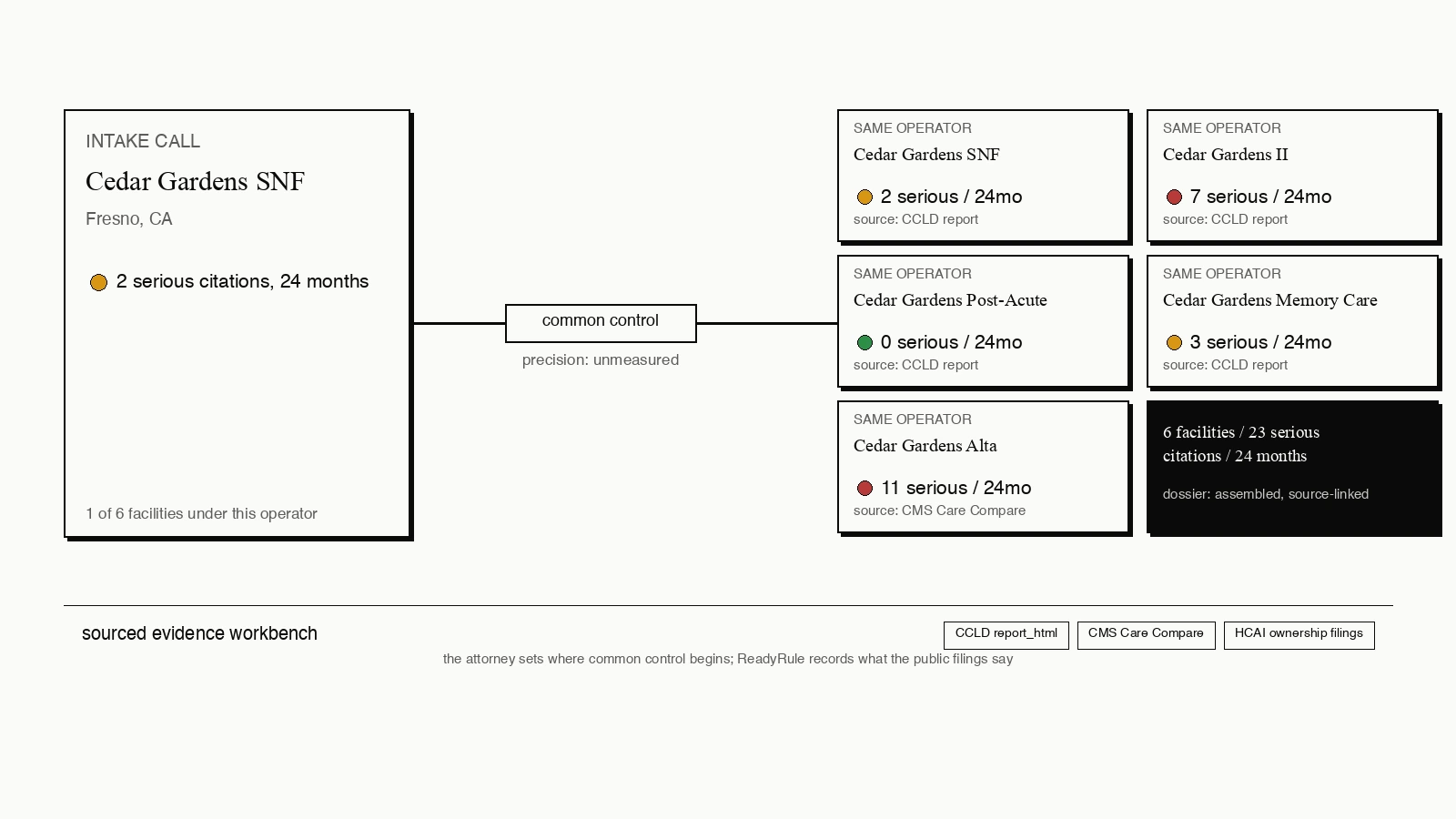
California skilled-nursing facilities are linked to their common owner from public ownership filings inside ReadyRule, with the harm record across every facility in the footprint severity-ranked in seconds.
For a plaintiff-side elder-abuse attorney, the consequence is operational.
One intake call about a single facility can become a chain-liability evaluation before the next step in the matter is scoped.
The connection between facilities is the part no single inspection report shows.
The work an inspection report does not do
Every licensed care facility has a public inspection record, scattered across state PDFs.
The report names what happened inside one building.
The other buildings under the same operator, the prior serious-harm citations on those buildings, and the portfolio-wide pattern sit in different reports, often in different states.
ReadyRule turns those PDFs into one common-control record: which facilities the ownership filings place under the same operator, and the harm record across all of them.
Plaintiff-side elder-abuse attorneys use that record to convert a single-facility intake into a chain-liability evaluation.
A workbench, not an oracle
The attorney sets where common control begins; ReadyRule records what the public filings say.
The ownership clustering ships with pipeline precision marked unmeasured, so ReadyRule asserts no reproducible ownership determination and carries a confidence indicator rather than a flat claim.
The deliverable follows the depth.
The full deliverable is called a dossier where the file can be assembled at full depth; it is called a workup where coverage is partial.
The seconds-fast intake surface is a lookup, a trigger rather than a deliverable.
California skilled-nursing is where the ownership records run deepest and where the assembled dossier reaches full depth today.
Sourced facts, severity-ranked, no conclusion rendered
The data an attorney works in is concrete.
As of the 2026-06-17 load, ReadyRule holds 631,731 CMS citations, 115,120 CCLD report_html citations, 70,744 IA DIAL citations, 23,570 CA CDPH citations, 19,046 NY DOH NH citations, and 8,795 FL AHCA citations, against a registry of 126,292 facilities including 72,987 in California.
Illinois eldercare went live in prod on 2026-06-17 with 4,440 facilities, 304,300 visits, and 702 facilities CCN-bridged to CMS.
ReadyRule surfaces sourced facts with provenance and severity-ranked harm.
It never states the legal merits of a matter, never rates case strength, never asserts liability against a named operator.
The licensed professional draws the conclusion.
Ownership links are inferred from public ownership filings and may be incomplete or incorrect.
The customer must independently verify before relying on a common-control link.
The qui-tam door
The same common-control graph supports a qui-tam or False Claims Act theory: a single facility's billing or quality outlier, the owner behind it, and the portfolio-wide pattern.
DOJ's FOCUS initiative, announced in April 2026, prioritizes data-miner relators who bring pre-filing diligence.
FY2025 FCA recoveries were a record $6.8B, with $5.7B from health care, on 1,297 qui-tam filings.
These are public DOJ facts, not dossier or pilot-product claims.
Confidentiality on intake
The facilities an attorney searches and the case materials they bring are their confidential information.
ReadyRule never uses them to serve another customer and never shares search activity with the operators under investigation or their insurers.
Operators are subjects in the data with a right of verified factual correction, never paying customers.
No operator reputation product or portfolio report is sold to operators.
Request the sample dossier
A redacted sample dossier for a representative California skilled-nursing operator is available on request, in the format a partner reviews.
It shows the ownership cluster, the severity-ranked harm across the footprint, and the per-facility citation record.
No price is published.
To request the sample dossier or book a call, visit the elder-abuse discovery page.