
For Parent · Child care
How to Read a California Daycare Inspection Report
Field-by-field walkthrough of every section on the California LIC 809 inspection form. Learn what capacity, census, visit type, narrative, and deficiency codes actually mean for your child's safety.
California daycare inspection reports are public - but they're not designed for parents to read. They use licensing codes, abbreviations, and bureaucratic language that can make routine paperwork look alarming (or hide real problems in fine print). This is the definitive guide to reading them like a pro - field by field, form by form.
What You're Looking At
Every licensed California daycare has an inspection record maintained by the Community Care Licensing Division (CCLD). Each record contains:
- Facility information - name, license number, type, capacity
- Visit history - every inspection visit with dates and types
- Citations - each violation found, with codes, severity, and corrections
You can look up any facility's record on ReadyRule, which presents this data in plain English. But understanding the raw report helps you know what you're reading - and what to ask about at your next parent-teacher conference.
The state uses two main forms: the LIC 809 (Facility Evaluation Report) for the visit itself, and the LIC 809D (Deficiency Information) for each individual citation. Here's what every field means.
Anatomy of an Inspection Report (LIC 809)
When an inspector - formally called a Licensing Program Analyst, or LPA - visits a child care facility, they fill out a standard form called the LIC 809. Here's every field you'll see, top to bottom, and what it tells you.
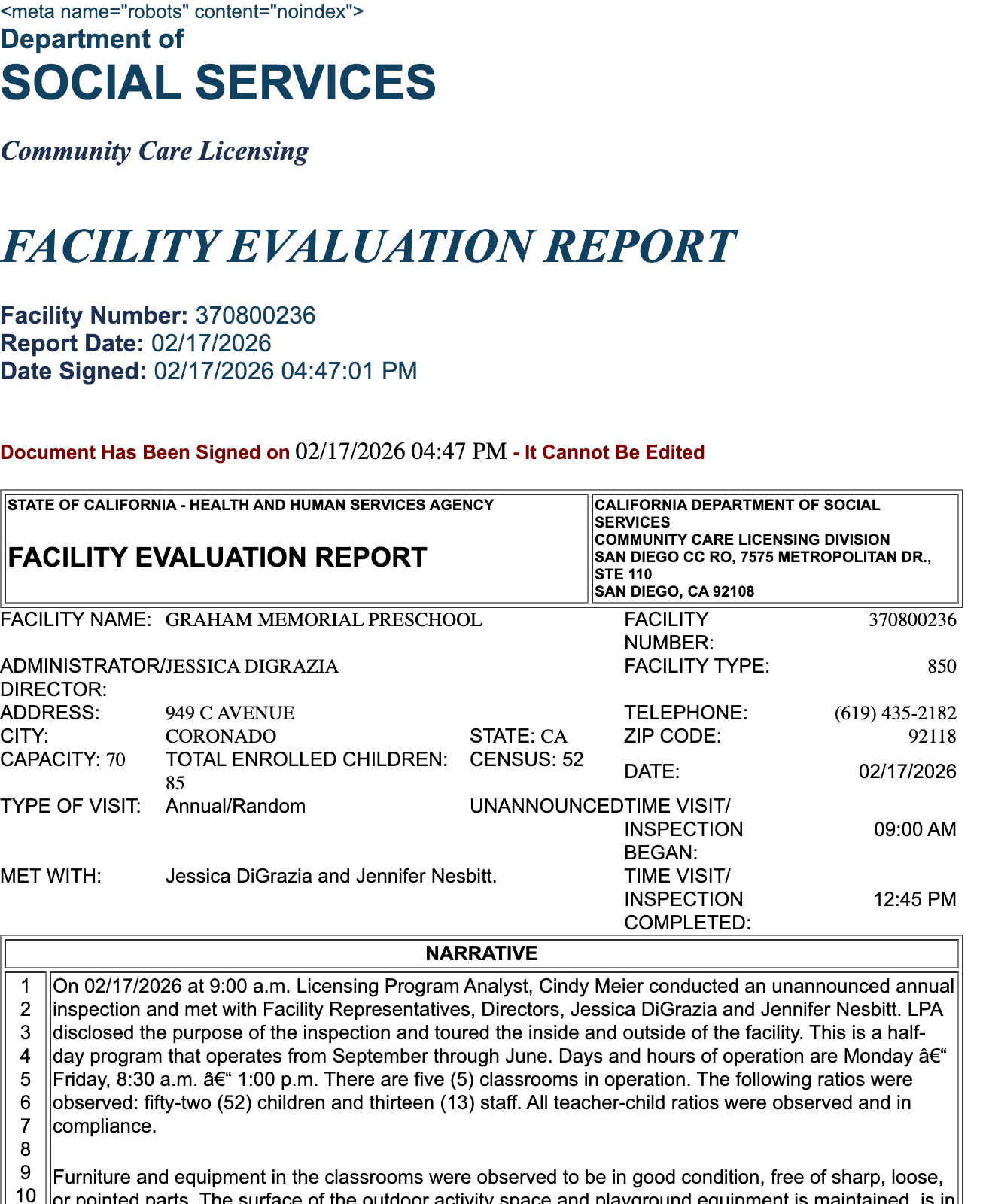 A real CCLD inspection report (LIC 809). The header, facility info, and narrative are packed into dense tables with small text.
Report Header
| Field on the Form | What It Means for Parents |
|---|---|
| FACILITY EVALUATION REPORT | This is a routine or scheduled inspection. If you see COMPLAINT INVESTIGATION REPORT instead, someone filed a concern with the state and the LPA is investigating it specifically. |
| Facility Number (e.g. 370800236) | The 9-digit unique ID assigned to this license. Use this to look up the facility on ReadyRule or on the CCLD website. Every facility has exactly one, and it never changes even if the name does. |
| Facility Name and Address | The licensed name and physical location. Note: the name on the license may differ from the name parents know - "Little Stars Learning Academy" might be licensed under the owner's name. |
Capacity and Census
This section tells you how big the facility is and how full it was during the visit.
| Field on the Form | Example | What It Means for Parents |
|---|---|---|
| CAPACITY | 70 | The maximum number of children allowed by the license. Going over this number is a violation. |
| TOTAL ENROLLED CHILDREN | 85 | How many children are currently enrolled. This can exceed capacity when a facility runs multiple sessions (e.g. a half-day morning and afternoon program). |
| CENSUS | 52 | How many children were physically present during the visit. Census vs. capacity shows how full the facility was that day. A census of 52 out of 70 capacity means the facility was well within its limit. |
Why census matters: Staff-to-child ratios are calculated against census (children present), not enrollment. A facility with 85 enrolled but 52 present only needs staffing for 52.
Visit Metadata
This section tells you when the visit happened, what kind it was, and how long it took.
| Field on the Form | Example | What It Means for Parents |
|---|---|---|
| Report Date / Date Signed | 02/17/2026 | The date the report was completed and signed. Reports are completed on-site the same day - not mailed later. What you see is what happened that day. |
| TYPE OF VISIT | "Annual/Random" | The reason for the visit. See Visit Types below for what each type means. |
| UNANNOUNCED | Present or absent | If you see this word on the form, the visit was unannounced. Nearly all CCLD visits are unannounced - the facility didn't know the LPA was coming. This is by design. |
| TIME BEGAN / TIME COMPLETED | 09:00 AM / 12:45 PM | How long the LPA was on-site. Routine annual inspections typically take 2-4 hours. Complaint investigations tend to be shorter (1-2 hours) because the LPA is investigating a specific concern rather than reviewing everything. |
People Involved
| Field on the Form | Example | What It Means for Parents |
|---|---|---|
| MET WITH | "Jessica DiGrazia and Jennifer Nesbitt" | The person at the facility who worked with the LPA during the visit. In this case both directors were present, but often it's whoever happens to be on-site. Don't read anything into who they met with. |
| LICENSING EVALUATOR NAME | "Cindy Meier" | The LPA (Licensing Program Analyst) who conducted the visit. This is the state inspector. |
| SUPERVISOR'S NAME | "Rajani Goudreau" | The LPA's supervisor at the CCLD regional office. Not someone at the daycare. |
The Narrative
The NARRATIVE section is the most valuable part of the entire report for parents. It's the LPA's free-text written account of the entire visit - what they observed, who they spoke with, what they checked, and what they found.
What to look for in the narrative:
- What was inspected - a thorough narrative mentions checking multiple areas (kitchen, outdoor play, nap rooms, staff files)
- Positive observations - LPAs do note things that are in compliance, not just violations
- Context for citations - the narrative often explains the circumstances around a deficiency in more detail than the citation form itself
- Staff interactions - how staff responded to the LPA can tell you about the facility's culture
What the narrative does NOT include: The narrative is factual, not evaluative. LPAs don't rate facilities as "good" or "bad" - they document what they observed.
Visit Types Explained
Not all inspections are the same. The TYPE OF VISIT field on the form tells you why the LPA was there:
Annual Inspection (Routine)
Every licensed facility gets at least one per year. This is a comprehensive review of the entire operation - staff qualifications, building safety, health practices, documentation, and more. An inspector typically spends several hours on site.
What it means for you: This is the baseline. Most facilities pass with zero or minor citations.
Complaint Investigation
Triggered when someone (a parent, staff member, neighbor, or anonymous caller) files a complaint with CCLD. The inspector investigates the specific concern.
What it means for you: A complaint visit doesn't mean the complaint was valid. But multiple complaint visits in a short period suggest multiple people have raised concerns.
Plan of Correction Follow-Up (POC)
After a citation, the facility submits a plan explaining how they'll fix it. A POC visit verifies they actually did.
What it means for you: If a POC visit results in the citation being cleared, the facility followed through. If it results in a re-citation, they didn't fix the problem.
Pre-Licensing Visit
Happens before a new facility opens or when ownership changes. Verifies the facility meets all requirements before being granted a license.
What it means for you: Purely procedural. Not a concern.
Random / Spot Check
Unannounced visits to verify ongoing compliance. Less common than annual inspections.
What it means for you: Similar to annual inspections but shorter. Clean spot checks are a positive signal.
Reading the Deficiency Section (LIC 809D)
When an LPA finds a violation, they document it on a separate form called the LIC 809D (Deficiency Information). A visit can have zero deficiencies (clean visit) or multiple. Each deficiency gets its own 809D.
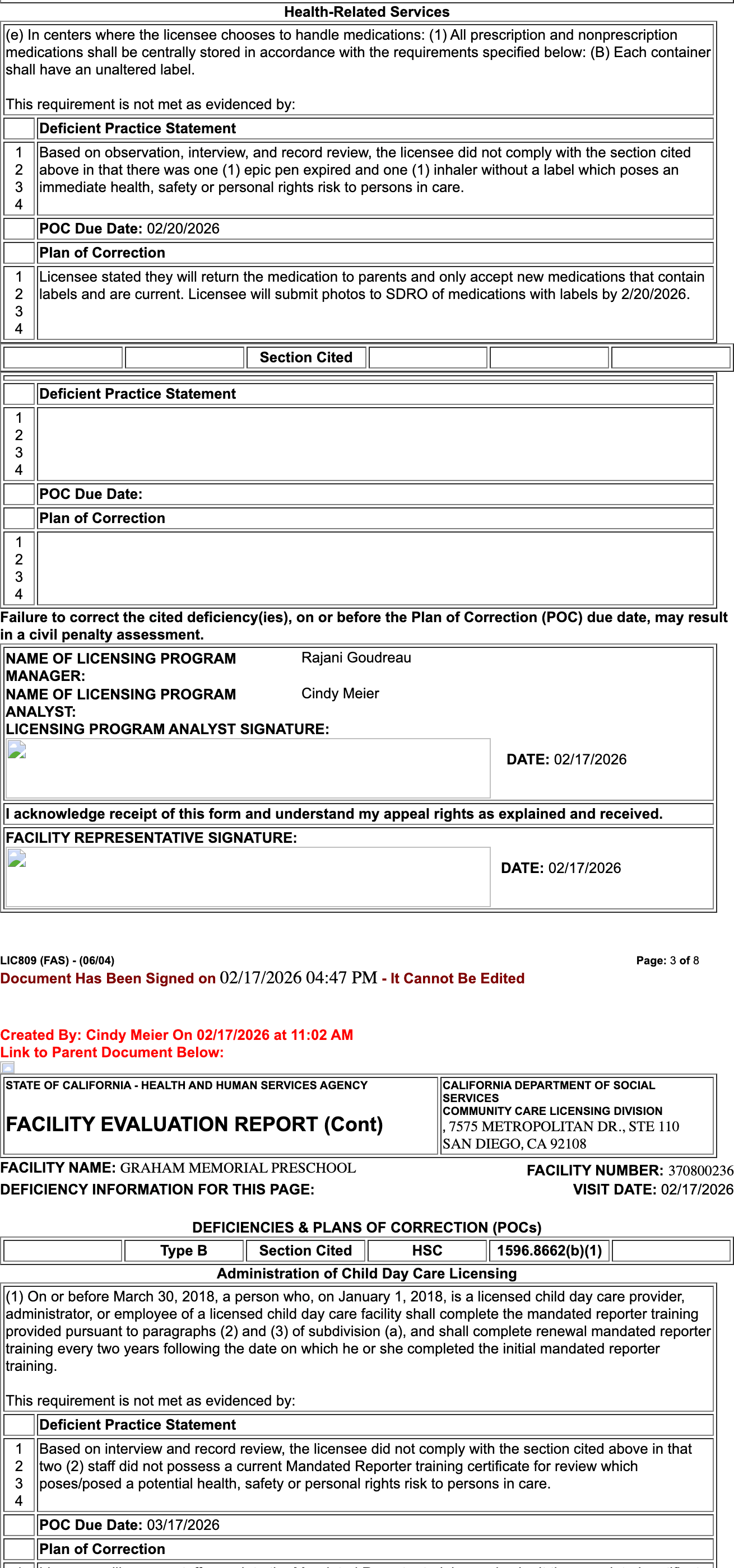 The deficiency section of a real report. Each citation lists the type (A or B), regulation code, what was found, the correction deadline, and the facility's plan to fix it.
Here's every field on the deficiency form and what it means:
| Field on the Form | Example | What It Means for Parents |
|---|---|---|
| Type A / Type B | "Type A" | Severity. Type A = immediate risk to health or safety. Type B = potential risk, not immediately dangerous. Read our full guide to what Type A means. |
| Section Cited | "CCR" or "HSC" | Which body of law was violated. CCR = California Code of Regulations (Title 22 - the daycare-specific rules). HSC = Health and Safety Code (broader state law). Most citations are CCR. |
| Regulation Number | 101226(e)(1)(B) | The specific regulation violated. You don't need to memorize these, but the number tells you what area of the operation is involved. |
| Category Name | "Health-Related Services" | A human-readable label for the regulation area. Categories include Personal Rights, Health-Related Services, Physical Environment, and others. |
| "This requirement is not met as evidenced by:" | Always present | This standard phrase introduces every deficiency. Everything after it is the actual finding. |
| Deficient Practice Statement | "One EpiPen expired and one inhaler without a label" | The most important text on the entire form. This is the specific thing the LPA found wrong. Read this carefully - it tells you exactly what happened. |
| POC Due Date | 02/20/2026 | The deadline for the facility to correct the issue. This tells you how serious the state considers it. |
| Plan of Correction | "Return medication to parents and only accept new medications with labels and current status." | What the facility committed to doing to fix the problem and prevent it from recurring. |
Common Citation Categories
You don't need to memorize regulation codes. What matters is the category and the type (Type A vs. Type B):
| Category | What It Covers | Example Code |
|---|---|---|
| Staff qualifications | Background checks, training, certifications | 1596.8662(b)(1) |
| Supervision & ratios | Adult-to-child ratios, supervision practices | 101216.3(a) |
| Health & safety | Medications, illness policies, hazards | Various |
| Building & environment | Fire safety, maintenance, outdoor areas | Various |
| Documentation | Required postings, records, notifications | 101212(b) |
What Good Plans of Correction Look Like
The Plan of Correction tells you how the facility responded. Look for:
- Specific actions: "Moved all cleaning supplies to locked cabinet in utility room"
- Systemic changes: "Added monthly staff certification audit to director's checklist"
- Clear timelines: "Completed immediately" or "Will be implemented by [date]"
Weak plans use vague language like "Will address the issue" or "Staff have been reminded" without describing what actually changed.
POC Deadlines Tell You About Severity
The Plan of Correction (POC) due date is one of the clearest signals of how serious a citation is. Based on our analysis of 60,857 citations across California:
- Type A median POC deadline: 1 day - 91% of Type A citations must be corrected within 7 days
- Type B median POC deadline: 14 days - 34% due in 8-14 days, 27% in 15-30 days
A same-day or next-day POC deadline means the state considers the issue urgent enough to demand immediate action. A 30-day deadline means it's important but not an emergency.
Civil Penalties
Not all citations result in fines, but when they do:
- $100 per day until the violation is corrected
- $250 plus $100 per day for repeat violations of the same regulation
- Reports must be available for public review for 3 years
- A notice of the site visit must be posted at the facility for 30 days
Citation Statistics: What's Normal?
Across 60,857 citations in California's database:
- 18.5% are Type A (immediate health/safety risk)
- 80% are Type B (potential risk)
- The remaining ~1.5% are other categories
A single Type B citation for a missing posting or an expired form in a staff file is extremely common and generally not cause for concern. A Type A citation for supervision failures or background check gaps deserves a closer look.
Red Flags vs. Routine: A Quick-Read Cheat Sheet
You don't need to read every line of every report. Here's how to quickly assess what you're looking at:
Green - Routine, No Concerns
- Clean narrative with no deficiencies listed
- Short visit duration (LPA didn't need to dig deeper)
- Multiple consecutive annual inspections with zero citations
Yellow - Worth Noting, Not Alarming
- Type B citations that were corrected by the POC due date
- One-time occurrences (a citation that appears once and never repeats)
- Administrative issues like a missing posting or expired form in a staff file
- Citations from 5+ years ago with a clean record since
Orange - Pay Attention
- Any Type A citation, especially for supervision (101229(a)(1)) or background checks (1596.871(c)(1)(A))
- Multiple citations in a single visit (3+)
- Complaint investigations that were "Substantiated" (the complaint was confirmed)
- POC corrections that took longer than the deadline
Red - Have a Conversation with the Director
- The same Type A citation repeated across multiple inspections
- Multiple visits in a short period (3+ visits in one year outside normal scheduling)
- Frequent complaint investigations from different sources
- Slow corrections (months, not days)
- Recent uptick in citations after years of clean inspections
The most telling signal isn't whether a facility has ever had a citation - it's whether the same issue keeps showing up. A one-time expired medication is very different from the third time supervision ratios were wrong.
What to Focus On (The 80/20)
If you're short on time, here's what matters most:
Read These Closely
- Type A citations - anything flagged as Type A is a health/safety concern
- The deficient practice statement - the specific text of what was found wrong
- Repeat violations - the same regulation code cited across multiple inspections
- Complaint visits - how many, and whether findings were substantiated
- POC timelines - how quickly issues were corrected vs. the deadline
You Can Safely Skim
- Pre-licensing visits (procedural, before the facility opened)
- Single Type B citations that were quickly corrected
- Citations from 5+ years ago with a clean record since
- Administrative codes related to paperwork formatting
- The LPA and supervisor names (unless you're filing a complaint yourself)
Putting It All Together
Here's a framework for evaluating any facility's record:
Strong Record
- Multiple annual inspections with zero or minimal Type B citations
- No complaint investigations (or complaints that were unsubstantiated)
- Quick corrections when citations occur
- No Type A citations
- Narrative describes thorough inspections of multiple areas
Average Record
- Some Type B citations, mostly administrative
- Occasional Type A citation that was corrected and not repeated
- One or two complaint investigations over several years
- Corrections completed by POC due dates
Concerning Record
- Multiple Type A citations, especially repeats of the same regulation
- Same issue cited across 3+ inspections
- Frequent complaint investigations
- Slow corrections (months past the POC deadline)
- Recent uptick in citations after a period of clean inspections
Look Up Your Daycare
Ready to read your daycare's inspection record? ReadyRule translates the raw CCLD data into plain English with context, risk scoring, and timeline views:
Search your daycare on ReadyRule
For a step-by-step walkthrough of finding and evaluating any daycare's record, read our complete guide to looking up daycare violations.
Frequently Asked Questions
What is the LIC 809 form?
The LIC 809 is the official "Facility Evaluation Report" used by California's Community Care Licensing Division (CCLD) to document every inspection visit to a licensed child care facility. It includes facility information, visit details, a narrative of what the inspector observed, and any deficiencies found.
What's the difference between a Facility Evaluation Report and a Complaint Investigation Report?
A Facility Evaluation Report (the standard LIC 809 header) documents a routine or scheduled inspection. A Complaint Investigation Report documents a visit triggered by someone filing a concern with CCLD. The form layout is the same - only the header and the reason for the visit differ.
What does "census" mean on an inspection report?
Census is the number of children physically present at the facility when the inspector arrived. It's different from enrollment (total signed up) or capacity (maximum allowed). Staff-to-child ratios are calculated against census, not enrollment.
Where can I find the original inspection reports?
The raw reports are available through California's CCLD website at ccld.dss.ca.gov. ReadyRule pulls from the same public data and presents it with context and plain-English explanations.
How current is the inspection data?
ReadyRule updates inspection data weekly from CCLD public records. There may be a short lag between an inspection and when it appears in the system.
What if I don't understand a specific citation code?
ReadyRule's violation pages explain each regulation code in plain English. You can also find common codes in our guide to what Type A citations mean and our overview of the top 10 citation types.
How many citations is "too many"?
There's no single number. Context matters more than count. A facility with three Type B citations for minor paperwork issues over five years has a very different record than one with three Type A citations for supervision failures in one year. Use the cheat sheet above to calibrate.
Do all citations result in fines?
No. Most citations result in a Plan of Correction (POC) requirement - the facility must fix the issue by a deadline. Civil penalties ($100/day until corrected) are typically reserved for serious or repeated violations.