

ReadyRule’s violations library lets you look up California childcare regulations in plain language. You can see what each regulation actually says, what inspectors look for in practice, and how to avoid common mistakes in your daily routines.Documentation Index
Fetch the complete documentation index at: https://readyrule.com/docs/llms.txt
Use this file to discover all available pages before exploring further.
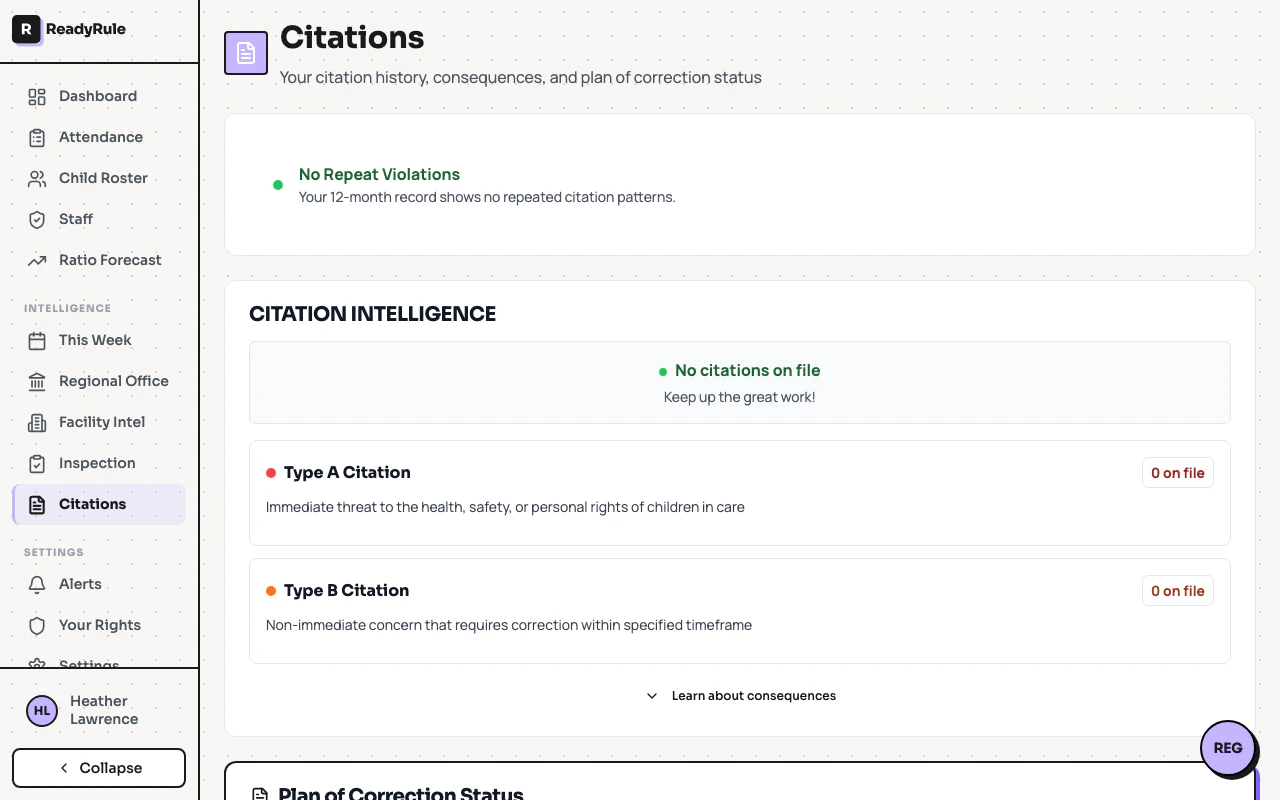
Quick start: finding the violations library
Go to the violations page
Navigate to readyrule.com/violations. You will see the main index of all California childcare violations with over 240 violation types tracked. Violations are organized by category:
- Staff & Supervision — ratios, qualifications, supervision requirements
- Health & Safety — handwashing, medication, illness protocols
- Records & Documentation — sign-in sheets, incident reports, attendance logs
- Nutrition & Food Service — meal schedules, food safety, allergy management
Reading a violation detail page
Citation text (top of page)
The first section is a white card containing the actual regulation text — the exact language that California law uses. If you understand the regulation, you know exactly what is expected of you during your shift.Insider’s tips
Right below the citation text, the section with a lightbulb icon gives you practical context: what situations commonly trigger this citation, what inspectors actually observe, and details the formal text does not make obvious.Statistics ribbon
| Number | What it means |
|---|---|
| Facilities cited | How many facilities statewide got this citation |
| Counties affected | How widespread the issue is across California |
| Rank | How common this violation is compared to all others |
| Trend | Whether it is being cited more or less often lately |
Prevention checklist
The most actionable section for staff. It lists specific steps to avoid the violation, with interactive checkboxes you can use to track your progress during a self-check.Common mistakes
A separate section lists mistakes that frequently lead to citations — things that seem minor but inspectors will flag.Regional data, FAQ, and related violations
- Regional data: Which California counties have the most citations in the past 90 days
- FAQ: Expandable answers to common questions
- Related violations: Up to three violations often cited alongside this one
How to use this in your daily work
Before your shift
If your director has flagged a specific area of concern (ratios, documentation, safety), look up the relevant violation and read the prevention checklist. It takes two minutes and reminds you what to watch for.During staff meetings
Your director may reference specific violation types. Look up the regulation code on the violations page afterward for the full picture.If an inspector visits
Inspectors follow a checklist based on these same regulations. If you have read the violations relevant to your role, you already know what they are looking for.After a citation
If your facility receives a citation, look up the regulation code and read the citation text, the prevention checklist, and the common mistakes section.Violations most relevant to staff
| Area | What to watch for |
|---|---|
| Supervision & Ratios | Correct child-to-staff ratios at all times, including transitions |
| Health & Hygiene | Handwashing protocols, illness exclusion, medication administration |
| Incident Reporting | Documenting injuries, behavioral incidents, and parent notifications |
| Attendance Records | Accurate sign-in/sign-out times, head counts |
| Indoor/Outdoor Safety | Age-appropriate equipment, clear exits, safe sleeping arrangements |
Understanding the terminology
| Term | Plain language |
|---|---|
| Deficiency | Something the inspector found that does not meet state requirements |
| Citation | A formal written notice for a serious deficiency, with possible fines |
| Type A | An immediate safety concern (most serious) |
| Type B | A concern that needs to be fixed but is not an immediate danger |
| Regulation code | The number that identifies a specific state rule (e.g., 101212) |
| Plan of Correction | The facility’s written plan for fixing the problem |
Troubleshooting
I heard about a violation but cannot find it
I heard about a violation but cannot find it
Use your browser’s search function (Ctrl+F on Windows, Cmd+F on Mac) on the violations index page. Type the regulation number or a keyword.
The regulation text is confusing
The regulation text is confusing
Read the Insider’s Tips section right below it for a more practical explanation. You can also ask your director or use the Compliance Chat feature.
I am not sure if something at my facility is a violation
I am not sure if something at my facility is a violation
Look up the regulation and compare the citation text against your current practice. If you are still unsure, raise it with your director. It is always better to ask.
Key takeaways
- You do not need to memorize regulation codes — just know where to look them up.
- Read the Insider’s Tips — they tell you what inspectors actually look for.
- Use the prevention checklists — they are written as actionable steps you can follow during your shift.
- Pay attention to trends — if a violation is trending upward, inspectors are actively looking for it.
- Check related violations — problems rarely come alone.