

When a CCLD evaluator visits your facility, you have specific legal rights under California law. ReadyRule provides a quick reference so you are always prepared.Documentation Index
Fetch the complete documentation index at: https://readyrule.com/docs/llms.txt
Use this file to discover all available pages before exploring further.
Quick start
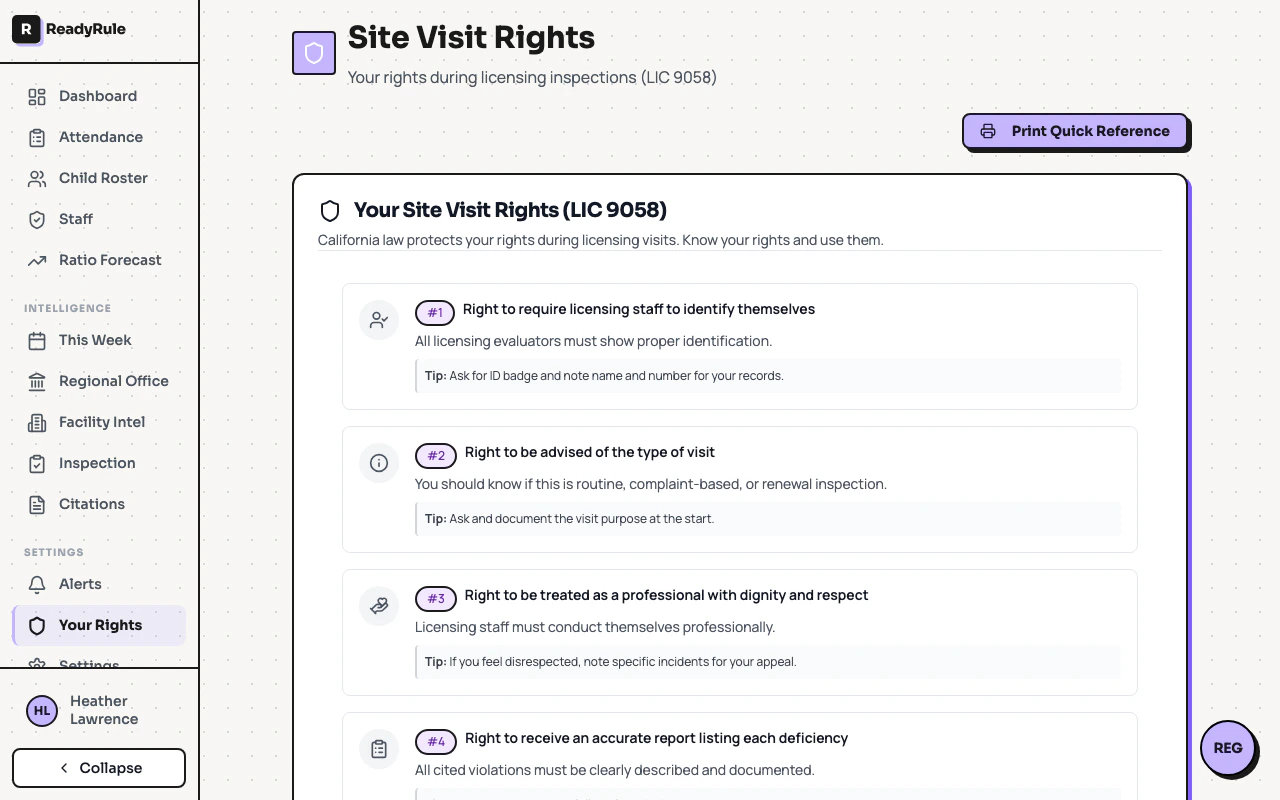
Your 11 site visit rights
California’s LIC 9058 form guarantees these rights during every licensing visit.1. Right to identification
Evaluators must identify themselves with a state ID badge. Ask for their name and ID number and write it down.2. Right to know visit type
You should be told if the visit is a routine annual inspection, complaint-based visit, POC follow-up, or renewal inspection. Ask at the start: “What type of visit is this?“3. Right to professional treatment
Evaluators must treat you with dignity and respect. If you experience unprofessional behavior, note specific incidents — time, words used, witnesses.4. Right to accurate documentation
Every cited deficiency must reference the specific regulation violated, include a clear description, and be factually accurate. Review the report carefully before signing.5. Right to review regulations
You can ask to see the exact regulation cited for any deficiency. Request the regulation number and look it up yourself.6. Right to impartial investigation
All complaints must be investigated fairly, without bias. Take notes during the investigation.7. Right to develop your POC
You can work with the evaluator during the visit to start planning your correction. Be proactive — suggest realistic timelines and specific steps.8. Right to agree or disagree
You can dispute findings if you believe they are wrong. Document your disagreement in writing at the exit interview.9. Right to exit interview
The evaluator must review findings with you before leaving and provide a signed copy of the report. Request the exit interview if it is not offered.10. Right to supervisor information
The report must include the evaluator’s supervisor name and phone number. Write this down immediately.11. Right to public file access
Your facility file is public record. You can request copies. Review your file periodically to ensure accuracy.Appeal rights
If you disagree with a citation, you have the right to appeal.Standard appeals path
| Level | Who decides | What to expect |
|---|---|---|
| First | Regional Manager | Reviews your written appeal |
| Second | Program Administrator | Final decision for most issues |
Serious matters path
For cases involving death, serious injury, or abuse:| Level | Who decides | What to expect |
|---|---|---|
| First | Deputy Director, CCLD | Higher-level initial review |
| Second | Administrative Law Judge | Formal hearing process |
Tips for successful appeals
- Be specific — Reference exact regulation numbers and specific facts
- Include documentation — Photos, witness statements, records
- Submit within 15 days — Late appeals are automatically denied
- You can add more — Submit additional documentation within 30 business days
- Expect a response — The agency must respond within 60 business days after receiving all information
- Bring support — You can have a representative at any meeting
During a visit checklist
- Ask for evaluator’s ID and write down their name
- Ask “What type of visit is this?”
- Accompany them during the inspection
- Take notes as they note findings
- Ask for regulation numbers for any citations
- Request the exit interview
- Read the report carefully before signing
- Note any disagreements in writing
- Get supervisor contact information
- Request your signed copy
Troubleshooting
Can I refuse entry to an evaluator?
Can I refuse entry to an evaluator?
No. Licensed facilities must allow CCLD access during operating hours. However, you can request identification first.
What if the evaluator is rude or unprofessional?
What if the evaluator is rude or unprofessional?
Document specifically what happened — time, exact words, witnesses. You can file a complaint with the Regional Manager using the supervisor information on the report.
Can I record the visit?
Can I record the visit?
California is a two-party consent state. You may record only if the evaluator agrees. You can always take written notes.
What if I don't agree with a finding but sign the report?
What if I don't agree with a finding but sign the report?
Your signature only acknowledges you received the report, not that you agree. Write “I disagree” next to specific items and explain in the comments section.
How do I prepare for an inspection?
How do I prepare for an inspection?
Review your current compliance status in ReadyRule, address any outstanding POC items, ensure staff certifications are up to date, have your records organized, and review this rights reference.